Design Futures: What Are We Designing Towards?
"Don't just imagine the car of the future, imagine the traffic jam."
Dunne and Raby said that, and it takes a second to register. Week 4 of Contemporary Design Culture was full of moments like it, things that sound obvious, until you actually think about them. The lecture was built around Design Futures, what it is, why designers should care, and how to actually do it. I went in expecting something abstract, and came out with a question I'm still trying to answer.
Where Do You Stand?
We started with something called the Polak Game. The room becomes a compass. You physically position yourself based on two things: whether you think the world is generally getting better or worse, and whether you feel you personally have any power to influence what happens next.
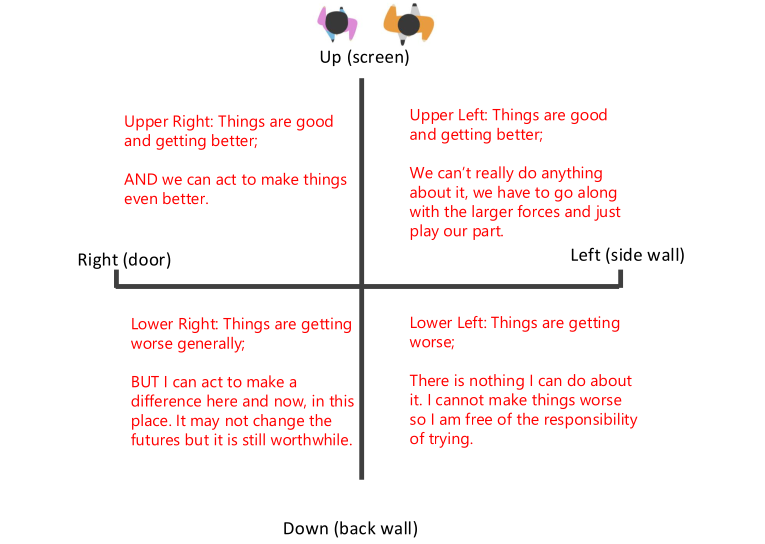
I went to the lower right, things are getting worse, but I can still act. That wasn't a difficult decision for me. Climate, politics, inequality; the overall trajectory isn't great and I don't think pretending otherwise helps anyone. But I also think what individual people do still matters, including what designers do. So lower right felt right. What I didn't expect was where some of my classmates ended up. Not going to name names, but a few positions genuinely surprised me, people I assumed would read the world similarly ended up somewhere completely different. It's a small thing but worth noting. If people training for the same career can stand in completely different corners of that room, that has real implications for the work we'll eventually put out.
The Future Cone and What Design Futures Actually Is
The core idea is this: design doesn't have to be reactive. It doesn't have to wait for a problem to exist before engaging with it. Design Futures is about taking possible futures seriously, imagining them in enough detail that you can actually do something with them. A framework called the Future Cone (Hancock and Bezold, 1994) maps this out. Picture a cone expanding forward from the present. The widest edge is everything that might happen. It narrows through what could happen, what's likely to happen, and at the centre, what's actually preferable. The point isn't to predict the future. It's to figure out which part of the cone you're working towards.
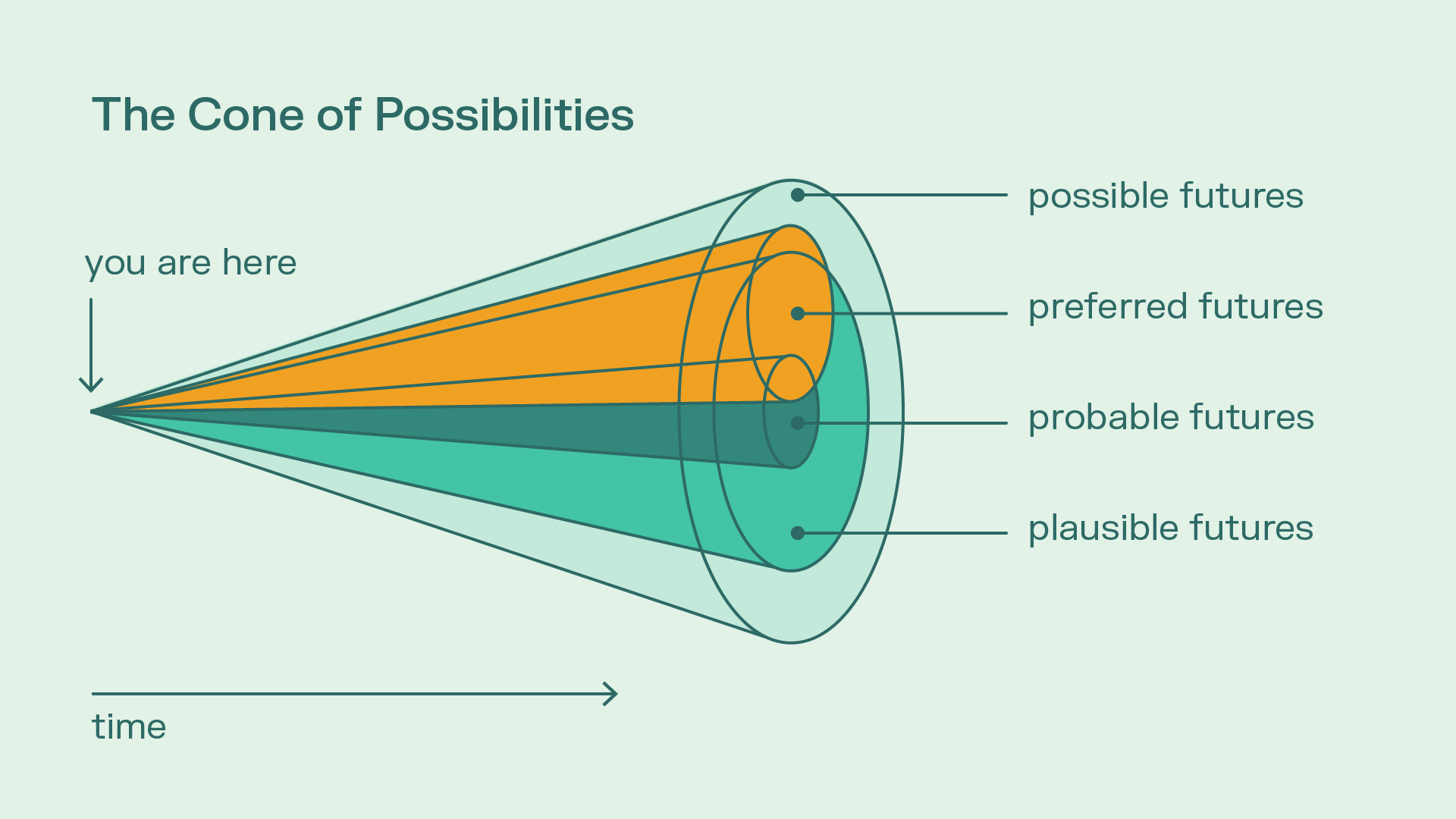
Future Cone (Hancock and Bezold, 1994)
The methods that fall under this, speculative design, critical design, design fiction, are more varied than I expected. World-building, cautionary tales, what-if scenarios, backcasting from a desired future. A lot of it exists in territory I already spend time in through photography. Framing is a choice. What you include and what you leave out shapes how someone reads an image, or a product, or a policy.
The Trolley Problem
I'd come across the Trolley Problem before, but the way it came up in this lecture was different.
The standard version is a philosophy exercise: a runaway trolley, a lever, five people versus one. It's intentionally detached from reality. But the point made in class was that designers are making these decisions all the time, they're just disguised. A self-driving car's collision logic. An algorithm deciding who sees what. A product built for one user group that gets used by another. The trolley problem is already in the work. It's just buried under enough layers of technical language that it stops looking like an ethical question.
That framing made me uncomfortable in a useful way. Car design is somewhere I'd like to end up, and the shift towards autonomous vehicles means this stuff isn't theoretical anymore. The ethics are structural, they go into the product at the start, not as an afterthought. You can't design around it.
The Case Studies
The part of the lecture I was most drawn to was the sci-fi angle. Blade Runner, Fallout, the idea that fictional worlds aren't just entertainment but function as rough drafts for futures that sometimes actually happen. It's something I've half-believed for a while. Seeing it treated as a legitimate design methodology was something I hadn't expected.
Apple's 1984 ad I already knew well. What was useful was the reframing, not just as a great piece of advertising, but as an act of design speculation. It showed a future worth being afraid of, grey, conformist, Orwellian, and placed the Mac as the thing that breaks it open. It wasn't selling a computer so much as selling an escape from a particular version of where things were going.
Tobias Wong I found annoying, honestly. The gilded everyday objects, the ironic consumer critique, I understand what it's doing intellectually but something about it doesn't work for me. It feels more interested in being clever than in changing anything. Maybe that's the point. Maybe I'm the wrong audience. But it got a reaction, so.
Syd Mead is someone whose work I'm a huge fan of. He designed the future for a living, literally, as a visual futurist on Blade Runner, Tron, and others, and the technology in those films preceded real products by decades. Whether that's coincidence or influence is probably impossible to unpick, but the PADD devices from Star Trek and the iPad are too similar to dismiss entirely.
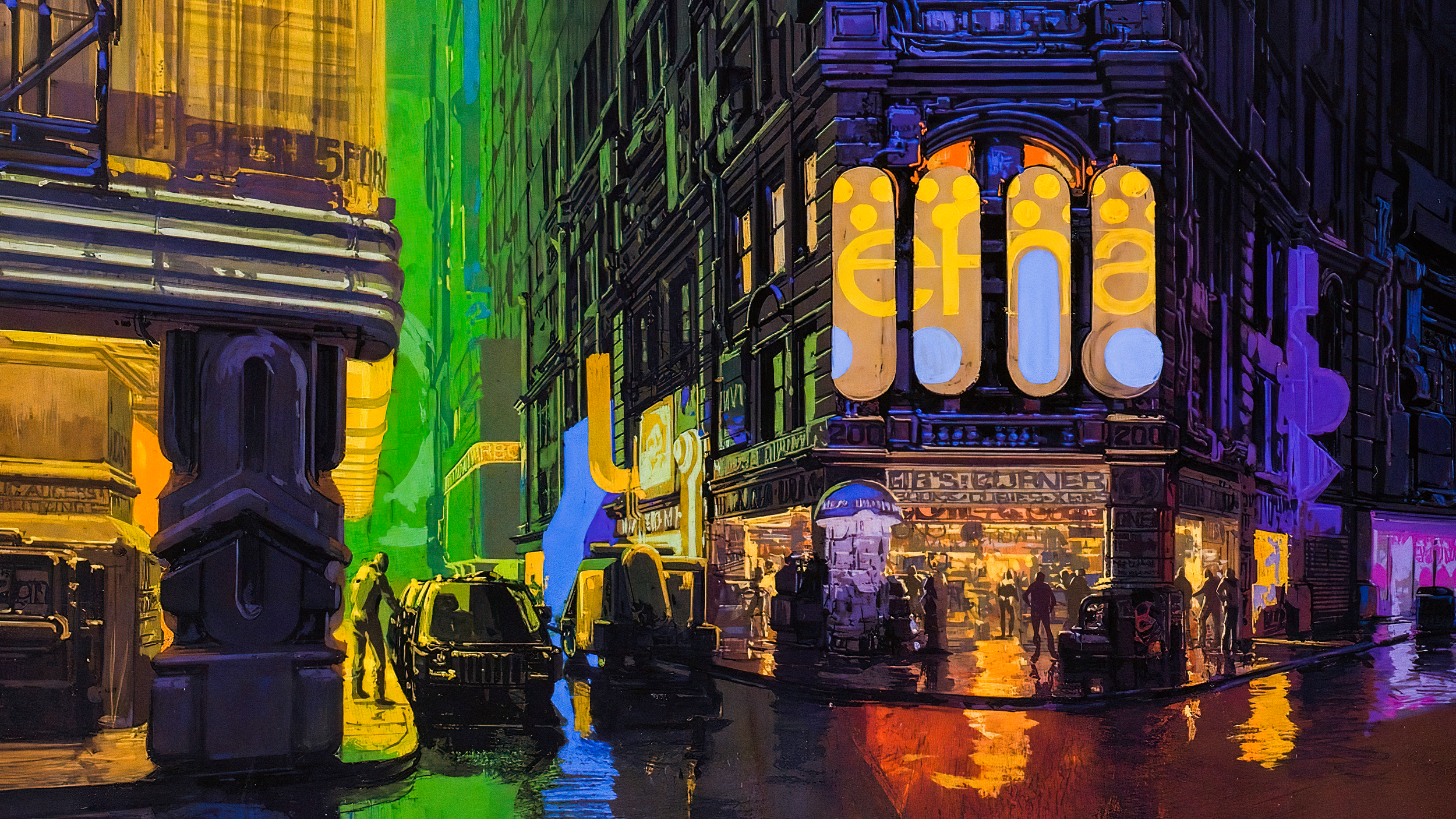
Corner Shop Concept Art For Blade Runner - Syd Mead
The Futures Bazaar
The session ended with a workshop, groups building objects from an assigned future world and presenting them as a market stall. The concept is interesting on paper. In practice it felt too abstract to get into properly, and we ran out of time before anything really clicked. I can see how it would work with more time and a clearer setup. This particular section didn't do much for me.
The Question I Can't Drop
Since this lecture I keep coming back to the same thing: what futures am I already designing towards, without having decided to?
Every design decision carries assumptions about the world it'll exist in. Who uses it, under what conditions, what values are baked into the form or the material or the interface. Most of the time those assumptions aren't examined, they come from the brief, or from convention, or from what's been done before. They just run in the background. I don't have a clean answer to this. I'm not sure I want to be heading into car design, or broader creative work, or engineering, probably some version of all three, probably not in any clean way. But whatever direction that takes, I'd rather be conscious about which futures I'm building towards than just default into them.
Design Futures, as a field, seems to be one way of developing that. I'm not yet clear on how it fits inside product design day to day. But it's the right thing to be thinking about.
