Design Visualisation: Sony DSC-H300
Developing vector illustrations and visual storytelling for digital camera features.
Role: Graphic Designer
|
Duration: 5 Days
|
Tools: Affinity Designer
|
Context: University Project
|
Role: Graphic Designer | Duration: 5 Days | Tools: Affinity Designer | Context: University Project |
Project Overview
This design visualisation project focused on product communication and visual storytelling for the Sony Cyber-shot DSC-H300 digital camera. The primary objective was to break down the camera's physical hardware and ergonomic design, translating those physical attributes into clear, communicative visual elements. By analysing the camera's interface, the project aimed to create a presentation poster that effectively explained how a photographer interacts with the device on a daily basis.
Exploration/Discovery
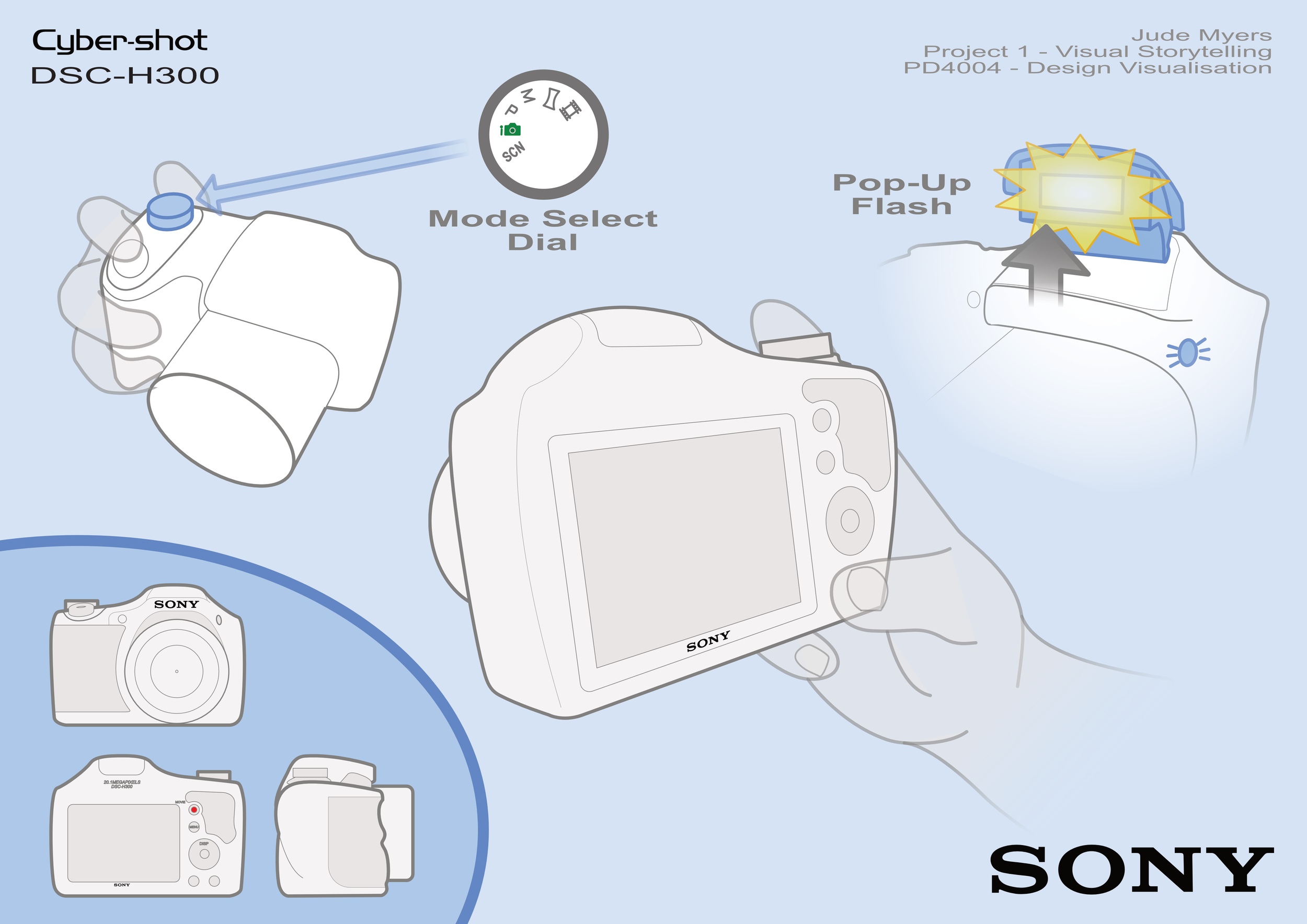
The initial phase required thoroughly analysing and photographing the camera to understand its key functional components in a real-world context. I explored specific hardware details, such as the 35x optical zoom lens that transitions from wide-angle to telephoto, and the ergonomic shutter button featuring an integrated zoom lever designed specifically for one-handed operation. I also sketched and documented other crucial physical interaction points, including the directional menu controls designed for intuitive thumb use, the mode select dial for quickly switching shooting modes without navigating digital menus, and the dedicated video record button intended for spontaneous filming.
Design Process
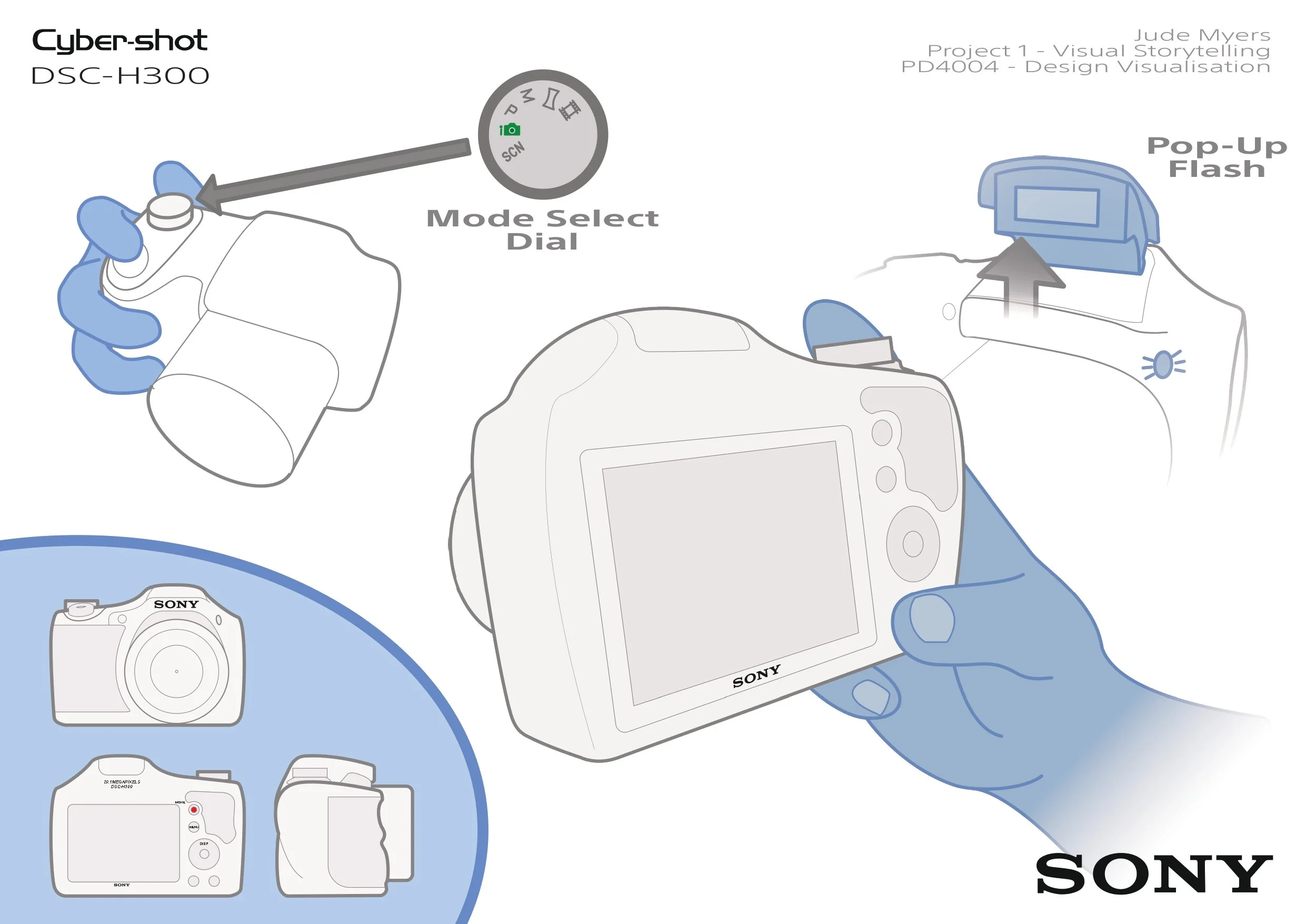
Following the initial ideation sketches and photography, I developed accurate orthographic views of the camera to serve as a baseline reference for creating digital vector elements. Using the linework for the back view of the camera, I experimented with multiple colour schemes to determine which combination best communicated the distinct features of the physical interface. To provide clear scale and demonstrate the camera in use, I integrated vector illustrations of a human hand interacting with both the front and back views of the device. Furthermore, I illustrated the pop-up flash mechanism to visually communicate its mechanical movement and physical separation from the main camera body, testing various colour contrasts to ensure the elements remained distinct.
Final Design
The final deliverable was a comprehensive presentation poster combining the generated vector graphics and detailed feature descriptions. The layout integrated the orthographic linework, the contextual hand illustrations, and the specific visual callouts detailing the mechanics of the mode select dial and pop-up flash. The composition was intentionally structured to guide the viewer through the camera's core functionalities, maintaining a clean and simple aesthetic to avoid visual clutter while fully explaining the product's physical usability.
Impact & Reflection
After completing the first iteration of the presentation poster, I submitted the work for critique and received actionable feedback regarding visual hierarchy. The feedback highlighted a need to utilise alternative colour schemes to provide greater visual contrast against the dark camera body, as well as a requirement to make the typography and descriptive text clearer for the reader. I directly applied these critiques to build a revised final poster, which significantly improved the overall contrast, legibility, and communicative power of the final visual story.